Lessons
Bass
The backbone of the band: the groove that links rhythm to harmony.
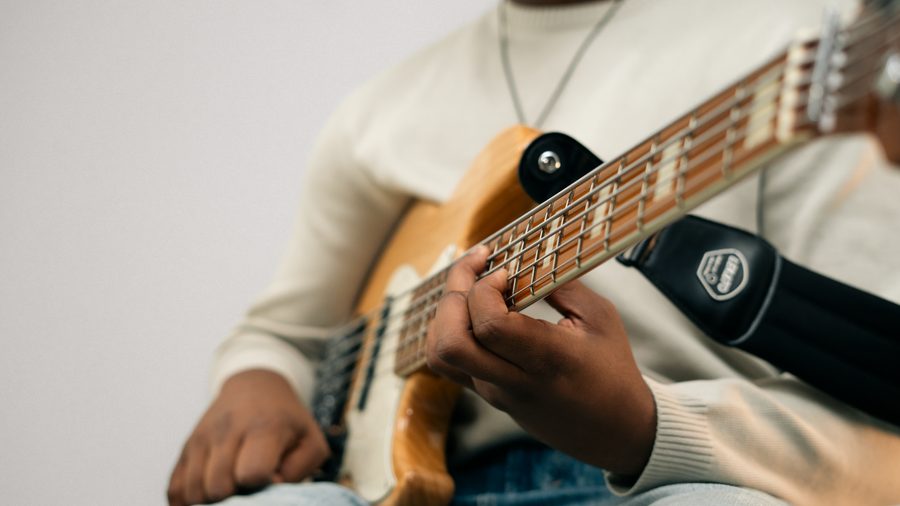
The backbone of the band: the groove that links rhythm to harmony.
6 levels, from the very first contact with the instrument to playing independently in a band. Each level runs 12 one-hour sessions.
In practice, the student learns to hold the bass, find their way around the neck and play clean notes in time with a metronome.
With others, they gradually learn to accompany a simple song from start to finish: counting in, coming in at the right moment, following the chord changes and stopping with the band.
Number system: chords are named with numbers (1, 4, 5…) instead of letters. It is the shared language of gospel musicians, and it lets you play the same song in any key. Triad: a three-note chord whose lowest note — the root — is the note a bass player learns to play first.
In practice, the student moves beyond the single root note of each chord to short bass lines, adding other chord notes, octaves and passing notes.
With others, they gradually learn to lock in with the drummer’s kick drum and to build a line that supports the song without covering it.
Major and minor triads: the two basic chord colours, one brighter, one darker. Pocket: the rhythmic understanding between bass and drums, when both land together. Walk-up and walk-down: a short run of rising or falling notes that leads from one chord to the next.
In practice, the student learns to work out a song by ear, vary their groove over the same progression and place short fills between two sections of a song.
With others, they gradually learn to converse with the drums, including on the swaying gospel 6/8, and to adjust how much they play.
Ghost notes: muted, almost pitchless notes that give the rhythm its texture. Pentatonic scales: five-note scales widely used for fills. Fill: a short phrase that lifts the music into a new section.
In practice, the student learns to sense where a progression is heading so they can anticipate the next chord, and to work out a bass line themselves by listening to a song.
With others, they gradually learn to adapt their line to each part of the song — verse, chorus, bridge — to follow the band’s energy as it rises and falls.
Seventh chords: richer four-note chords, very common in gospel. Chromaticism: using notes a half step apart to slide from one note to another. Walking bass: a line that keeps moving note after note, without a break.
In practice, the student learns to play anywhere on the neck, recognise the keyboard’s passing chords and adjust their line on the spot.
With others, they gradually learn to follow a key change mid-song and to build up a repeated section without losing the groove.
Modulation: a key change in the middle of a song. Vamp: a short section repeated in a loop, often at the end of a song, that the band builds in intensity. Passing chords: brief chords played between two main chords.
In practice, the student learns to approach an unfamiliar song quickly and to play without a pre-written line, from what they hear.
With others, they gradually learn to react live to the lead singer, keyboard and drums — repeats, stops, restarts — and to choose between playing, holding a note or leaving silence.
This final level brings together the vocabulary of the earlier ones. The focus is on listening and musical choices rather than new techniques.
This path outlines the planned learning at each level. The starting level and schedule are settled at enrolment.See the frequently asked questions ↓
From the first sessions we play as a group: listening to others, holding your part, coming in and out at the right time.
Our teaching is rooted in gospel and worship. Students learn to accompany a voice, not just to play notes.
A full rehearsal, then a performance in front of an audience — this session, on Monday, December 14, 2026. That is where the work makes sense.
Monday, September 21, 2026 → Monday, December 14, 2026
The session has started: before paying, write to us to check that a group can still take you. Same address for any question about the payments. Write to us →
One-on-one lessons: this rate does not apply. They are available on request, depending on the teacher’s availability.
If the student has their own, bringing it is ideal for practising between sessions. If not, write to us before enrolling and we will tell you what is available on site.
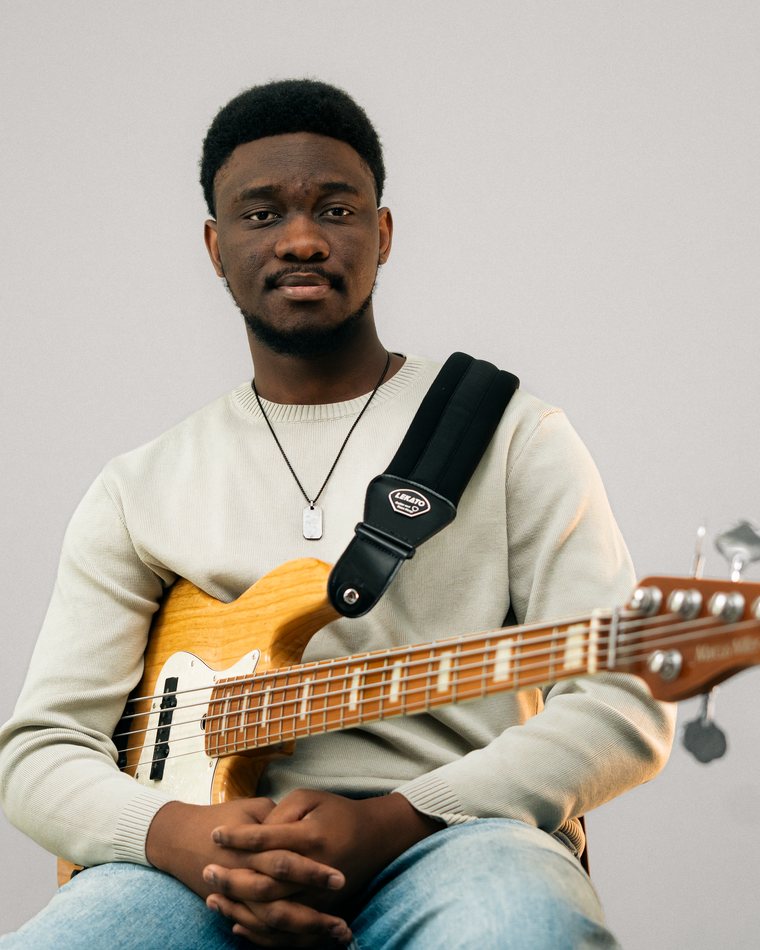
The bass has four lower strings and a different role: it links rhythm to harmony and acts as the band’s foundation. You hear it less, but you feel it — it is what moves the song forward.
On the enrolment form, you state the student’s level. Someone who has never played starts at the first level. If they already play, write to us before enrolling and we will work out the right group together. From the second level on, each level also starts with a review session.
Classes are on Mondays. This session: Beginner 1 : 6–7 p.m.. For other levels the schedule is not set yet — write to us and we will confirm it before the first class.
You receive a confirmation email summarising your enrolment. We then get back to you with the practical details — group, day and time — before your first class.
Another question? Write to us →